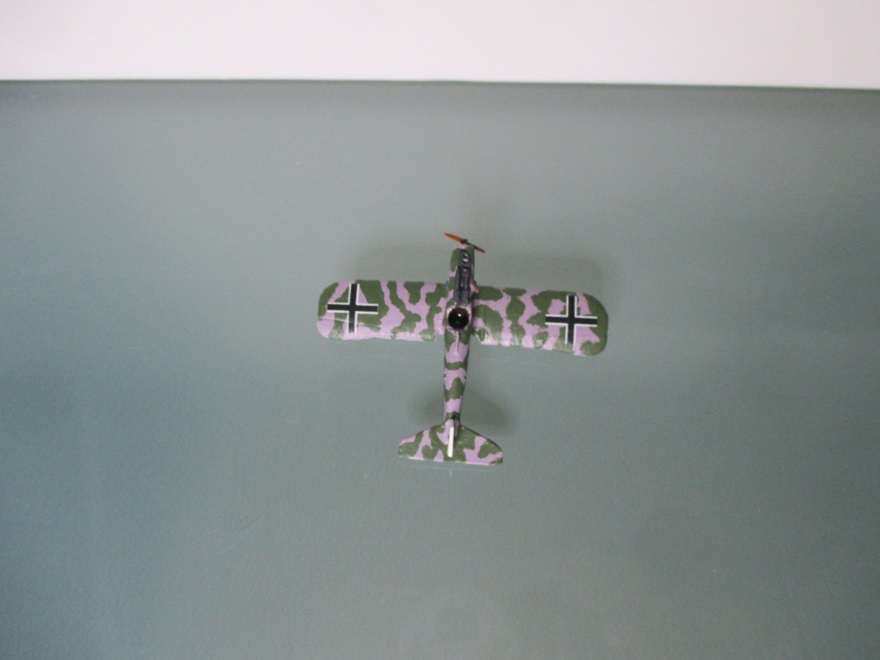
Un blog de miniatures d'avions en métal à l'échelle 1/144.
En kit ou Diecast.
Avec des exceptions : un peu de plastique et de résine, des véhicules d'aéroport, et un porte-avions léger en construction aussi au 1/144...

A blog of metal aircraft miniatures at 1/144 scale.
Kit or Diecast.
With exceptions : some plastic and resin, airport vehicles, and a light aircraft carrier under construction also at 1/144...
Affichage des articles dont le libellé est # Germany. Afficher tous les articles

mercredi 1 avril 2026

1/144 Fokker D.VII

J'ai l'impression qu'en ce moment, je suis en train de vider le "placard de la honte" de tous les modèles commencés et abandonnés à des stades de montage différents, et qui viennent d'être présentés dernièrement une fois enfin terminés : comme le Short 184 (voir ici), le Gloster Gladiator (voir là) ou encore le DFW Floh (voir ici).

C'est aussi le cas pour ce Fokker D.VII.

J'avais déjà monté 2 D.VII, il y a quelques années déjà (dont le bleu marine et rouge faisait partie des premiers kits que j'ai faits) mais..., j'ai toujours eu envie d'en faire un troisième...

Ce n'était pas seulement parce que c'est un bel avion, mais surtout que dans le cadre de la frénésie qui m'habitait à l'époque, où je stockais tout le matériel au 1/144 que je trouvais, j'avais acheté une planche de décals auprès d'un fabriquant amateur.

Il a fallu du temps pour que je me décide à attaquer la construction de ce kit composé comme d'habitude d'un mélange des kits en métal Reviresco et Skytrex, ce que j'ai fait en 2022 (date de la photo ci-dessous) avec notamment la peinture grise pour intégrer la décalque autour des personnages qui était d'un gris différent.


I feel like I'm currently emptying the ‘shame closet’ of all the models I started and abandoned at different stages of assembly, which have recently been presented now that they are finally finished: such as the Short 184 (see here), the Gloster Gladiator (see there) and the DFW Floh (see here).

This is also the case for this Fokker D.VII.

I had already built two D.VIIs a few years ago (the navy blue and red one was one of the first kits I ever built), but... I always wanted to build a third one...

It wasn't just because it's a beautiful aircraft, but mainly due to the frenzy that gripped me at the time, when I was stockpiling all the 1/144 scale material I could find, I had bought a sheet of decals from an amateur manufacturer.

It took me a while to decide to tackle the construction of this kit, which, as usual, consists of a mixture of Reviresco and Skytrex metal kit, which I did in 2022 (date of the photo below), notably painting it grey to blend in the decal around the characters, which was a different shade of grey.


1/144 Fokker D.VII diecast metal aircraft miniature


Et puis, je n'ai rien fait pendant 3 ans, jusqu'à ces derniers jours où j'ai décidé de faire du vide dans le "placard de la honte"....

J'ai donc repris le montage de ce biplan, avec la difficulté liée à la pose des décalques en losange spécifique des avions allemands à la fin de la 1e Guerre Mondiale, et provenant d'un kit Valom.

Mais si ces décalques sont légèrement surdimensionnées et permettent de faire le tour des bords des ailes, elles sont difficiles à coller, et assez cassantes surtout avec le Micro Sol, sans parler de leur fragilité lors des manipulations du modèle pendant le montage.

Un petit mot sur cette décoration : L'avion du pilote allemand Alfred Bäder (deux victoires) porte sur chaque côté du fuselage un dessin tiré d’un vieux conte médiéval intitulé "Die Sieben Schwaben" (Les Sept Souabes), qui raconte plusieurs aventures de sept habitants du Duché de Souabe (sujet habituel de moqueries) dont une objet de cette décoration, à savoir la rencontre avec un lièvre qu'ils prennent pour un monstre (sur un côté) et le font courageusement fuir avec une longue lance (de l'autre côté)....


And then, I did nothing for three years, until recently when I decided to clear out the “cupboard of shame”...

So I resumed assembling this biplane, with the difficulty of applying the diamond-shaped decals specific to German aircraft at the end of the First World War, and from a Valom kit.

But if these decals are slightly oversized and wrap around the edges of the wings, they are difficult to apply and quite brittle, especially with Micro Sol, not to mention their fragility when handling the model during assembly.

A quick note about this decoration : German pilot Alfred Bäder's aeroplane (two victories) has a drawing on each side of the fuselage taken from an old medieval tale entitled ‘Die Sieben Schwaben’ (The Seven Swabians), which recounts several adventures of seven inhabitants of the Duchy of Swabia (a subject of frequent ridicule), including one subject of this decoration, namely including their encounter with a hare that they mistake for a monster (on one side) and bravely chase away with a long spear (on the other side)....


1/144 Fokker D.VII diecast metal aircraft miniature


Et voici donc après plusieurs années de pause, un Fokker D.VII avec cette décoration si particulière des 7 Souabes (désolé, mais à cause des mats et de l'ombre de l'aile supérieure, on ne voit pas le lièvre).


And so, after several years' break, here is a Fokker D.VII with the distinctive livery of the 7 Swabians (sorry, but because of the poles and the shadow cast by the upper wing, we cannot see the hare).


1/144 Fokker D.VII diecast metal aircraft miniature
Le pilote est à droite - The pilot is on the right


1/144 Fokker D.VII - Jasta 65 - Imperial German Army

1/144 Fokker D.VII diecast metal aircraft miniature

1/144 Fokker D.VII diecast metal aircraft miniature

1/144 Fokker D.VII diecast metal aircraft miniature

1/144 Fokker D.VII diecast metal aircraft miniature

1/144 Fokker D.VII diecast metal aircraft miniature

 
1/144 Fokker D.VII diecast metal aircraft miniature


VOIR PLUS - SEE MORE :


mercredi 25 mars 2026

1/144 DFW T.28 Floh

Embauché au sein de l'entreprise DFW (Deutsche Flugzeug-Werke), l'ingénieur touche à tout Hermann Dorner a conçu un avion de chasse de petite taille, profilé pour optimiser l'aérodynamisme afin de surpasser les avions Eindecker dont la vitesse maximale était de 140 km/h.

Cet appareil principalement axé sur la vitesse et équipé d'un moteur Mercedes de 100 ch entièrement intégré au fuselage, semblant sortir d'un dessin animé, a été nommé Floh, soit "puce" par son concepteur...

Malgré son aspect surprenant, en février 1916, le T.28 Floh a été le premier avion au monde à atteindre la vitesse de 180 km/h en vol horizontal.

Mais les choix de conception pour améliorer la vitesse ont eu des conséquences négatives : Le profil haut de l'avion, l'emplacement de l'aile supérieure et la position du pilote limitaient la visibilité vers l'avant et vers le bas, en particulier lors du décollage ou de l'atterrissage, lors duquel l'avion a été endommagé lors du premier vol.

On voit bien sur la photo ci-dessous l'absence de visibilité du pilote au regard de sa position derrière l'aile supérieure, placée plus haut.

Peu après, le Floh s'est écrasé lors d'un autre vol d'essai, blessant gravement son pilote, et détruisant totalement l'avion qui n'a pas été reconstruit.


Hired by DFW (Deutsche Flugzeug-Werke), the versatile engineer Hermann Dorner designed a small fighter plane with a streamlined profile to optimise aerodynamics and outperform Eindecker planes, which had a maximum speed of 140 km/h.

This aircraft, designed primarily for speed and equipped with a 100 hp Mercedes engine fully integrated into the fuselage, looks like something out of a cartoon. Its designer named it Floh, meaning ‘flea’.

Despite its surprising appearance, in February 1916, the T.28 Floh was the first aircraft in the world to reach a speed of 180 km/h in horizontal flight.

However, the design choices made to improve speed had negative consequences : the aircraft's high profile, the location of the upper wing and the position of the pilot limited forward and downward visibility, particularly during take-off and landing, during which the aircraft was damaged on its maiden flight.

The photo below clearly shows the pilot's lack of visibility due to his position behind the upper wing, which was placed higher up.

Shortly afterwards, the Floh crashed during another test flight, seriously injuring its pilot and completely destroying the aircraft, which was not rebuilt.


1/144 DFW T.28 Floh diecast metal aircraft miniature


Le modèle présenté a été coulé en métal sur la base d'un kit en impression 3D du fabricant japonais V1 Models, particulièrement bien conçu notamment pour la pose des mats entre les ailes.

Les deux "difficultés" ont été, la première de trouver un gris très léger, à la limite du blanc mais sans l'être, et la seconde, de réaliser les bordures noires sur les ailes et ailerons, en gardant un trait fin et régulier.

J'ai finalement réussi à faire ces bordures noires grâce à un feutre de peinture, mais quand même après quelques sueurs froides....

Voici donc au 1/144, ce très curieux petit appareil qui non seulement a volé, mais a été le plus rapide de son époque...

Une dernière chose : j'ai choisi de placer l'hélice dans une position horizontale, pour mieux profiter de l'avant de cet avion.....


The model shown was cast in metal based on a 3D-printed kit from Japanese manufacturer V1 Models, which is particularly well designed, especially for installing the masts between the wings.

The two ‘difficulties’ were, first, finding a very light grey, almost white but not quite, and second, creating the black borders on the wings and ailerons, keeping the lines fine and even.

I finally managed to make these black borders using a paint marker, but after a few cold sweats....

Here, then, in 1/144 scale, is this very curious little aircraft which not only flew, but was the fastest of its time...

One last thing : I chose to place the propeller in a horizontal position to make better use of the front of this aircraft...


1/144 DFW T.28 Floh diecast metal aircraft miniature


1/144 DFW (Deutsche Flugzeug-Werke) T.28 Floh

1/144 DFW T.28 Floh diecast metal aircraft miniature

1/144 DFW T.28 Floh diecast metal aircraft miniature

1/144 DFW T.28 Floh diecast metal aircraft miniature

1/144 DFW T.28 Floh diecast metal aircraft miniature

1/144 DFW T.28 Floh diecast metal aircraft miniature

jeudi 20 mars 2025

1/144 Heinkel He 70 "Blitz" - Part 2

Voici donc la suite (et fin) de la présentation de ce Heinkel He 70.

Si la plus grosse difficulté a été le montage des trains d'atterrissage qu'il a fallu créer de toutes pièces, la peinture d'ensemble, la pose des décalques et la peinture noire à poser après, n'ont pas posé de problème.

Voici donc le Heinkel He 70 dénommé "Sperber", ce qui signifie Epervier, aux couleurs de la Lufthansa.


Here is the continuation (and end) of the presentation of this Heinkel He 70.

While the biggest challenge was assembling the landing gear, which had to be created from scratch, the overall painting, the application of the decals, and the subsequent black paint job were no problem.

So here is the Heinkel He 70 called "Sperber", which means Sparrowhawk, in the colors of Lufthansa.


1/144 Heinkel He 70 Lufthansa diecast metal aircraft miniature


1/144 Heinkel He 70 - Lufthansa

1/144 Heinkel He 70 Lufthansa diecast metal aircraft miniature

1/144 Heinkel He 70 Lufthansa diecast metal aircraft miniature

1/144 Heinkel He 70 Lufthansa diecast metal aircraft miniature

1/144 Heinkel He 70 Lufthansa diecast metal aircraft miniature

1/144 Heinkel He 70 Lufthansa diecast metal aircraft miniature

1/144 Heinkel He 70 Lufthansa diecast metal aircraft miniature


VOIR PLUS - SEE MORE :


mardi 18 mars 2025

1/144 Heinkel He 70 "Blitz" - Part 1

Développé dans les années 30 à la demande de la Deutsche Luft Hansa, le Heinkel He 70 était un avion postal rapide pouvant transporter 4 passagers, outre deux membres d'équipage, un pilote et un navigateur en tandem dans le cockpit.

Cet avion particulièrement élégant comportait des avancées techniques pour réduire la trainée, dont une aile elliptique aérodynamique, une finition extérieure lisse, un radiateur compact rétractable et un train d'atterrissage lui aussi rétractable.

Avant de servir comme bombardier, puis avion de reconnaissance par la Luftwaffe, notamment pendant la Guerre d'Espagne, le Heinkel He 70 a été utilisé par la Lufthansa jusqu'en 1937 pour des vols rapides entre Berlin et Francfort, Hambourg et Cologne, et aussi sur le début de la ligne postale vers l'Amérique du Sud, entre Stuttgart et Séville, mais la suite du trajet étant opérée par des hydravions via Las Palmas, puis Bathurst, en Gambie, jusqu'à Natal au Brésil.

Cela fait des années que je rêvais d'ajouter cet avion à ma collection, car je le trouve particulièrement élégant, surtout avec sa livrée de la Lufthansa.

Un jour, par désespoir, j'ai acheté un modèle Shapeways de Heinkel He 70, qui était fourni dans cet espèce de plastique granuleux, sans trains d'atterrissage mais seulement une hélice que j'ai finalement conservée qui, si elle est conforme dans sa taille, est un peu épaisse.


Developed in the 1930s at the request of Deutsche Luft Hansa, the Heinkel He 70 was a fast mail plane capable of carrying four passengers, plus two crew members, a pilot, and a navigator in tandem in the cockpit.

This particularly elegant aircraft featured technical advances to reduce drag, including an aerodynamic elliptical wing, a sleek exterior finish, a compact retractable radiator, and retractable landing gear.

Before serving as a bomber, then reconnaissance aircraft by the Luftwaffe, notably during the Spanish Civil War, the Heinkel He 70 was used by Lufthansa until 1937 for fast flights between Berlin and Frankfurt, Hamburg and Cologne, and also on the beginning of the postal line to South America, between Stuttgart and Seville, but the rest of the journey being operated by seaplanes via Las Palmas, then Bathurst, in Gambia to Natal in Brazil.

I've been dreaming of adding this plane to my collection for years, as I find it particularly elegant, especially in its Lufthansa livery.

One day, out of desperation, I bought a Shapeways model of the Heinkel He 70, which came in that kind of grainy plastic, with no landing gear, just a propeller. I ended up keeping it, which, while true to size, is a bit thick.


1/144 Heinkel He 70 Lufthansa diecast metal aircraft miniature


Sauf que c'était la version postérieure à celle des modèles utilisés par la Lufthansa, avec le cockpit qui, vers l'arrière, s'efface dans le fuselage.

Je l'ai finalement coulé en métal en 2024, et s'il est "bien sorti", il avait conservé son caractère granuleux, puisque le silicone conserve bien les détails, en particulier les pires.

Mais, comme je devais bien affiner les ailes, cela n'a pas été un problème..., pas plus que la rectification de l'arrière du cockpit.

La seule réelle difficulté (du montage) a été les trains d'atterrissage qui sont particulièrement complexes (et il ne faut pas y regarder de trop près sur mon modèle....). 


Except that it was the later version than the models used by Lufthansa, with the cockpit which, towards the rear, disappears into the fuselage.

I finally cast it in metal in 2024, and while it "came out well," it retained its grainy character, since silicone preserves details well, especially the worst ones.

But, since I had to refine the wings, this wasn't a problem... nor was straightening the rear of the cockpit.

The only real difficulty (during assembly) was the landing gear, which is particularly complex (and you shouldn't look too closely at it on my model...).


1/144 Heinkel He 70 Lufthansa diecast metal aircraft miniature


Début des travaux sur les trains et les trappes - Work on landing gear and hatches begins
1/144 Heinkel He 70 Lufthansa diecast metal aircraft miniature


Mais.... il y avait le problème de la livrée.....

J'avais envisagé dans un premier temps de la faire en peinture (avec sans doute de belles coulées de sueur, des moments de colère et de désespoir....).

Finalement, j'ai trouvé des décalques de ce modèle au 1/72 réalisées par CTAmodels qui, s'il m'a dit qu'il ne pouvait pas réduire ses planches à l'impression, m'a toutefois très gentiment proposé de m'adresser un fichier réduit à la bonne échelle.

En possession de ce fichier, j'ai pu le transmettre à la société spécialisée Customdecal qui a pu me les éditer.

Donc, un grand merci à ces deux entreprises.

Et le résultat ?
Réponse dans le prochain message....


But... there was the problem of the livery...

I had initially considered painting it (no doubt with some sweaty moments, anger, and despair...).

Finally, I found decals of this 1/72 scale model made by CTAmodels, who, while they told me they couldn't scale down their sheets for printing, very kindly offered to send me a file reduced to the correct scale.

In possession of this file, I was able to send it to the specialized company Customdecal, who was able to edit them for me.

So, a big thank you to both of these companies.

And the result ?
Answer in the next post...


VOIR PLUS - SEE MORE :


mardi 2 avril 2024

1/144 Heinkel He 178 V1

A la suite des recherches de l'ingénieur allemand Hans-Joachim Pabst von Ohain sur la turbine à gaz, l'avionneur Heinkel a conçu le Heinkel He 178, un avion expérimental de construction mixte métal et bois qui sera le premier avion au monde à voler grâce à la poussée d'un turboréacteur.

Le Heinkel He 178 V1 a réalisé son vol premier vol en août 1939, d'une durée de 6 minutes.
Mais l'avion n'a pas impressionné les responsables de la Luftwaffe, avec seulement une vitesse maximale de 598 kilomètres par heure et une autonomie tout aussi faible faible...

Heinkel a ensuite développé un autre prototype à réaction, mais cette fois bimoteur, le He 280, puis réalisera à la fin de la guerre, le Heinkel 162 qui, lui, sera en service, mais trop tard.


Following the research of the German engineer Hans-Joachim Pabst von Ohain on the gas turbine, the aircraft manufacturer Heinkel designed the Heinkel He 178, an experimental aircraft of mixed metal and wood construction which will be the first aircraft in the world to fly thanks to the thrust of a turbojet.

The Heinkel He 178 V1 made its first flight in August 1939, lasting 6 minutes.
But the plane failed to impress Luftwaffe officials, with only a maximum speed of 598 kilometers per hour and an equally low range...

Heinkel then developed another jet prototype, but this time twin-engined, the He 280, then produced at the end of the war, the Heinkel 162 which was in service, but too late.


1/144 Heinkel He 178 diecast metal aircraft miniature


Le modèle présenté ici a été coulé en métal à partir du kit en impression 3D réalisé par Dameya.

Le montage et la décoration n'ont pas posé de problèmes si ce n'est que j'ai failli faire une erreur en envisageant de créer des trappes pour les trains d'atterrissage, telles qu'elles apparaissaient sur certaines photos trouvées sur internet (voir ci-dessus).

Mais en réalité, les photos du Heinkel 178 avec des trappes de train d'atterrissage représentent le plus souvent le second prototype, le V2, qui volait uniquement comme planeur non motorisé et qu'on reconnait aux bouts d'ailes carrés.

Le Heinkel He 178 V1, que l'on reconnaît ci-dessous, notamment sur les photos tirées du film du premier vol (les photos floues), avec les bouts d'ailes arrondis, avait certes un train d’atterrissage classique mais qui a été maintenu fixe.


The model shown here was cast in metal from the 3D printed kit made by Dameya.

The assembly and decoration did not pose any problems except that I almost made a mistake when considering creating landing gear doors, as they appeared in some photos found on the internet (see above).

But in reality, photos of the Heinkel 178 with landing gear doors most often represent the second prototype, the V2, which flew only as an unpowered glider and which can be recognized by the square wingtips.

The Heinkel He 178 V1, which we recognize below, in particular in the photos taken from the film of the first flight (the blurry photos), with the rounded wingtips, did have conventional landing gear, but which was kept fixed.


1/144 Heinkel He 178 diecast metal aircraft miniature


1/144 Heinkel He 178 V1 - prototype

1/144 Heinkel He 178 diecast metal aircraft miniature

1/144 Heinkel He 178 diecast metal aircraft miniature

1/144 Heinkel He 178 diecast metal aircraft miniature

1/144 Heinkel He 178 diecast metal aircraft miniature

1/144 Heinkel He 178 diecast metal aircraft miniature

1/144 Heinkel He 178 diecast metal aircraft miniature

mercredi 20 mars 2024

1/144 Junkers D.I

Le Junkers D.I, ou J.9 selon la désignation de son constructeur, dont le premier vol est intervenu en Avril 1918, était le premier avion de chasse entièrement métallique.

Apparu trop tardivement, et moyennement apprécié par les pilotes qui préféraient le Fokker D.VII, le Junkers D.I a quand même été commandé pour l'aéronautique navale, mais a surtout été utilisé après la guerre par les « Freikorps » contre les communistes.

Le modèle provient d'un kit en métal du fabricant Reviresco, tout à fait exact quant aux dimensions, et qui a juste nécessité un peu de travail pour accentuer l'effet "tôle ondulé" d'un avion Junkers.

Le modèle présenté est, selon la revue Windsock Datafile, le prototype de série, qu'on reconnaît aux renforts au niveau du train d'atterrissage, disparus sur les modèles de série (ainsi qu'en l'absence de numéro de série sur le fuselage).


The Junkers D.I, or J.9 according to its manufacturer's designation, whose first flight took place in April 1918, was the first all-metal fighter plane.

Appearing too late, and moderately appreciated by pilots who preferred the Fokker D.VII, the Junkers D.I was still ordered for naval aeronautics, but was mainly used after the war by the “Freikorps” against the communists.

The model comes from a metal kit from the manufacturer Reviresco, completely accurate in terms of dimensions, and which just needed a little work to accentuate the "corrugated metal" effect of a Junkers plane.

The model presented is, according to the magazine Windsock Datafile, the production prototype, which can be recognized by the reinforcements on the landing gear, missing on the production models (as well as the absence of a serial number on the fuselage ).


1/144 Junkers D.I diecast metal aircraft miniature


1/144 Junkers D.I - prototype

1/144 Junkers D.I diecast metal aircraft miniature

1/144 Junkers D.I diecast metal aircraft miniature

1/144 Junkers D.I diecast metal aircraft miniature

1/144 Junkers D.I diecast metal aircraft miniature

1/144 Junkers D.I diecast metal aircraft miniature

1/144 Junkers D.I diecast metal aircraft miniature

mercredi 18 janvier 2023

1/144 Arado Ar 196

Résultat du second moule complet commandé à M. Chaubet (voir ici), et réalisé sur la base d'un kit en résine provenant de Petersplane (avant qu'il ne décide d'arrêter de produire des kits en résine dont un nombre important sortaient de l'ordinaire....),  voici l'Arado Ar 196, célèbre hydravion de reconnaissance catapultable, ayant équipé les principaux cuirassés et croiseurs de la Kriegsmarine.

Le montage s'est très bien passé (surtout avec une bonne base comme les modèles de M. Chaubet) et pour la livrée, parmi une planche de décals du fabricant français FFSMC Productions dédiée aux Arado 196 notamment du navire Admiral Hipper, j'ai choisi un avion aux faux marquages français sur le navire corsaire Widder.


Result of the second complete mold ordered from Mr. Chaubet (see here), made on the basis of a resin kit from Petersplane (before he decided to stop producing kits in resin, many of which were out of the ordinary....), here is the Arado Ar 196, a famous catapultable reconnaissance seaplane, having equipped the main battleships and cruisers of the Kriegsmarine.

The assembly went very well (especially with a good base like Mr. Chaubet's models) and for the livery, among a sheet of decals from the French manufacturer FFSMC Productions dedicated to the Arado 196, notably from the ship Admiral Hipper, I chose a plane with false French markings on the privateer ship Widder.


1/144 Arado Ar 196 diecast metal aircraft miniature

1/144 Arado Ar 196 diecast metal aircraft miniature


1/144 Arado Ar-196A-2 - 5./BoFIGr196 (5./Bordfliegergruppe 196) - Auxiliary Cruiser HSK Widder

1/144 Arado Ar 196 diecast metal aircraft miniature

1/144 Arado Ar 196 diecast metal aircraft miniature

1/144 Arado Ar 196 diecast metal aircraft miniature

1/144 Arado Ar 196 diecast metal aircraft miniature

1/144 Arado Ar 196 diecast metal aircraft miniature

1/144 Arado Ar 196 diecast metal aircraft miniature

mercredi 10 novembre 2021

1/144 Blohm & Voss Bv 141

Lorsque j'étais gamin, j'étais fasciné par cet avion, et surtout ou peut être uniquement, par le boxart.....


When I was a kid, I was fascinated by this plane, and above all or perhaps only, by the boxart.....


1/144 Blohm & Voss Bv.141 diecast metal aircraft miniature


J'avais toujours eu envie de le réaliser, mais à l'époque des grosses taches de colle et de peinture, je ne m'en sentais pas capable.... et cette impression est restée....
J'ai même été tenté de le réaliser comme ça....😁😇


I had always wanted to do it, but at the time of the big stains of glue and paint, I did not feel capable of it.... and this impression remained....
I was even tempted to realize it like that ....😁😇


1/144 Blohm & Voss Bv.141 diecast metal aircraft miniature


Et cet avion est resté d'autant plus inaccessible, qu'ayant rejoint le monde du 1/144, mais en métal, je ne pensais jamais en trouver ou en monter un.

Puis l'été dernier, lors de ma saison intensive de moulage et coulage, je me suis rappelé que le fabricant de résine Anigrand en avait produit un comme bonus d'un Junkers Ju 352 Herkules.

Alors, "chaud-bouillant" comme on dit dans le Sud, j'ai commandé cette maquette Anigrand et j'ai fait un moule puis j'ai coulé en métal ce Blohm & Voss Bv 141.


And this plane remained all the more inaccessible since having joined the world of 1/144, but made of metal, I never expected to find or built one.

Then last summer, during my intensive molding and casting season, I remembered that resin maker Anigrand had produced one as a bonus from a Junkers Ju 352 Herkules.

So, "hot-boiling" as they say in the South of France, I ordered this Anigrand model and I made a mold then I cast this Blohm & Voss Bv 141 in metal.


1/144 Blohm & Voss Bv.141 diecast metal aircraft miniature


Le problème essentiel de ce modèle est la verrière.
Pas seulement sa peinture, mais comme j'étais en vacances, je n'avais pas mon matériel habituel et j'ai un peu merdé le montage de la verrière sur le 2éme fuselage.

La seconde difficulté tient à ce que la gravure de la verrière, particulièrement les montants, est un peu proéminente à mon gout.
J'aurais peut être du tenter de les poncer un peu plus, mais j'ai eu peur de perdre alors le schéma des montants de la verrière.

Et, est-ce que vous imaginez la séance de masquage de la verrière....?


The main problem with this model is the canopy.
Not only his painting, but since I was on vacation, I didn't have my usual equipment and I messed up the assembly of the canopy on the 2nd fuselage.

The second difficulty is that the engraving of the canopy, in particular the uprights, is a bit prominent for my taste.
I should perhaps have tried to sand them a little more, but I was afraid of losing the diagram of the amounts of the canopy.

And, do you imagine the canopy masking session ....?


1/144 Blohm & Voss Bv.141 diecast metal aircraft miniature


Enfin, motif de satisfaction, j'ai pu faire la même immatriculation que le modèle Airfix, qui existait vraiment et pas une lubie de dessinateur, le B-02 (V10) - WNr 0210002 NC+RA....

Et voici donc, au 1/144, en métal, un Blohm & Voss Bv.141 (qui entre aussi parfaitement dans la catégorie de la nostalgie des modèles Airfix.....😇😎👀).

Mais, le temps de me remettre de mes émotions, je referais peut être la peinture de la verrière, après l'avoir poncée....


Finally, reason of satisfaction, I was able to make the same registration as the Airfix model, which really existed and not a designer whim, the B-02 (V10) - WNr 0210002 NC + RA ....

And here is, at 1/144, in metal, a Blohm & Voss Bv.141 (which also fits perfectly into the category of nostalgia for Airfix models....😇😎👀).

But, the time to recover from my emotions, I might redo the painting of the canopy, after having sanded it ....


1/144 Blohm & Voss Bv.141 diecast metal aircraft miniature


1/144 Blohm & Voss Bv.141  - Luftwaffe (Rechlin test center)

1/144 Blohm & Voss Bv.141 diecast metal aircraft miniature

1/144 Blohm & Voss Bv.141 diecast metal aircraft miniature

1/144 Blohm & Voss Bv.141 diecast metal aircraft miniature

1/144 Blohm & Voss Bv.141 diecast metal aircraft miniature

1/144 Blohm & Voss Bv.141 diecast metal aircraft miniature

1/144 Blohm & Voss Bv.141 diecast metal aircraft miniature