Un blog de miniatures d'avions en métal à l'échelle 1/144.
En kit ou Diecast.
Avec des exceptions : un peu de plastique et de résine, des véhicules d'aéroport, et un porte-avions léger en construction aussi au 1/144...

A blog of metal aircraft miniatures at 1/144 scale.
Kit or Diecast.
With exceptions : some plastic and resin, airport vehicles, and a light aircraft carrier under construction also at 1/144...
Affichage des articles dont le libellé est Horten Ho 229. Afficher tous les articles

jeudi 4 avril 2024

1/144 Musée des premiers avions à réaction - Museum of Early Jet Airplanes

Après avoir terminé le Heinkel He 178,  je me suis dit que je pourrais présenter tous les premiers jets ayant volé que j'avais dans ma collection dans un seul et même ensemble.
Pour ça, j'ai ressorti un diorama de musée, rangé dans un carton par manque de place, pour les présenter tous.
Je sais, il en manque certains : Gloster G40 Pioneer, Arado 234, Nakajima Kikka, Northrop xp-79 pour les plus connus et ceux figurant dans le créneau d'entre deux guerres et 2ème guerre mondiale.
Mais, ceux que j'ai sont déjà pas mal.


After finishing the Heinkel He 178, I thought I could present all the early flying jets that I had in my collection in one set.
For this, I took out a museum diorama, stored in a box due to lack of space, to present them all.
I know, some are missing : Gloster G40 Pioneer, Arado 234, Nakajima Kikka, Northrop xp-79, for the best known and those appearing in the interwar and World War 2 niche.
But, the ones I have aren't bad.


Ouvrir dans un nouvel onglet pour les détails - Open in a new tab for details
1/144 Early Jet Museum diecast metal aircraft miniature


De gauche à droite - From left to right

1/144 Early Jet Museum diecast metal aircraft miniature

* Heinkel He 178 V1 (kit en impression 3d de V1 Models coulé en métal - 3d printing kit from V1 Models cast in metal)

* Heinkel 280 (modèle fini en métal des Créations Chaubet - finished metal model from Creations Chaubet)

* Caproni-Campini N.1 (kit en résine de Kamide Koro Koro coulé en métal - Kamide Koro Koro resin kit cast in metal)


1/144 Early Jet Museum diecast metal aircraft miniature

* Heinkel He 162A (kit en métal de Mr Toki - Mr Toki metal kit)

* Messerschmitt 262 (modèle fini en métal des Créations Chaubet - finished metal model from Creations Chaubet)

Messerschmitt 163 Komet (modèle F-Toys (WKC 6) coulé en métal - F-Toys model (WKC 6) cast in metal)

* Horten Ho 229 (modèle en impression 3D en métal complété avec les trains d'atterrissage et peint - 3D metal print model completed with landing gear and painted)


1/144 Early Jet Museum diecast metal aircraft miniature

* Bell P-59 Airacomet (modèle fini en métal des Créations Chaubet - finished metal model from Creations Chaubet)

* Gloster Meteor Mk.III (modèle fini en métal de Diverse Images repeint et redécoré - finished metal model from Diverse Images repainted and redecorated)

* Gloster Meteor Mk.III ((modèle fini en métal de Diverse Images - finished metal model from Diverse Images)

VOIR PLUS - SEE MORE :
Heinkel 178V1
Heinkel 280
Caproni-Campini N1
Messerschmitt  262
Messerschmitt 163 Komet
Heinkel 162A
Horten Ho 229
Gloster Meteor Mk.III (camo)
Gloster Meteor Mk.III (white)
Bell P-59 Airacomet


mercredi 14 février 2018

1/144 Horten Ho 229 - Part 2

Comme vous avez du le comprendre à la lecture du long message de présentation du Horten Ho 229 (voir ici), j'ai trouvé extraordinaire, à l'époque où cela s'est déroulé, que l'on puisse non seulement inventer, mais créer une aile volante, si moderne qu'il aura fallu attendre 50 ans, avec le B-2, pour la voir en unités de première ligne.


As you must have understood from reading the long presentation message of the Horten Ho 229 (see here), I found extraordinary, at the time when it happened, that one can not only invent, but create a flying wing, so modern it took 50 years, with the B-2, to see it in front-line units.


Alors, quand j'ai vu sur Shapeways un modèle de Horten Ho 229, non seulement au 1/144, mais également en métal, je n'ai pas hésité une minute, je l'ai bien sûr acheté.

Les vérifications faites dans un premier temps avec le modèle F-Toys, puis avec celui de Brengun opportunément sorti au moment où j'ai commencé à monter le Horten, ont démontré que le modèle Shapeways était parfaitement conforme (même si on peut s'interroger sur l'épaisseur de l'aile, mais on retrouve la même interrogation sur tous les modèles moulés artisanaux).

Le seul problème de l'impression 3D, ou de la fabrication additive, ressort de son nom : on retrouve, en particulier sur les modèles en métal, les lignes de matière ajoutée.


So when I saw on Shapeways a Horten Ho 229 model, not only at 1/144, but also in metal, I did not hesitate a minute, I, of course, bought it.

The checks first made with the F-Toys model, and then with the one from Brengun, which was conveniently released when I started to mount the Horten, showed that the Shapeways model was perfectly in line (although we can question the thickness of the wing, but we find the same question on all the molded craft models).

The only problem of 3D printing, or the additive manufacturing, comes out of its name : we find, especially on metal models, lines of added material.

1/144 Horten Ho 229 diecast aircraft

On les voit bien, non ?
Et là, inutile d'envisager de poncer ces lignes d'ajout de matière : le matériau est excessivement dur, on risque de faire disparaître les quelques lignes de gravure des volets, et on ne peut pas poncer mécaniquement sans risque d'affecter les parties arrondies comme les réacteurs ou le cockpit.
Alors, une seule solution, le mastic.


One can see them well, right ?
And there, no need to consider sanding these lines of addition of material :the material is excessively hard, there is a risk of making disappear the few lines of engraving of the shutters, and one can not sand mechanically without risk of affecting the rounded parts like the reactors or the cockpit.
So, only one solution, putty.

1/144 Horten Ho 229 diecast aircraft

Ce qu'il y a de bien avec le mastic, c'est qu'il en faut toujours plus, et plus on en rajoute et plus on ponce, plus il faut en remettre.
Et quand vous avez l'impression que c'est bon, et que vous commencez à peindre, on s'aperçoit qu'il en faut encore et encore.
Je déteste le mastic.


The good thing about mastic is that you always need more, and the more you add and the more you sand, the more you have to put it back.
And when you have the impression that it's good, and you start painting, you realize that you need it again and again.
I hate putty.

1/144 Horten Ho 229 diecast aircraft

Une fois réglé ce problème, j'ai voulu utiliser les trains d'atterrissage du modèle F-Toys que j'avais, plus conformes que ceux du modèle Brengun, mais deux nouvelles difficultés :
- il a été pratiquement impossible de faire le moindre trou dans le modèle, sans doute en raison des multiples couches liées à la construction additive,
- ce qui a obligé à réduire la hauteur de trains d'atterrissage (sauf de celui de l'avant qui a une conception différente).


Once  this problem solved, I wanted to use the landing gear of the F-Toys model that I had, more conform than those of the Brengun model, but two new challenges :
- it was practically impossible to make any holes in the model, probably because of the multiple layers of additive construction,
- thus forcing to reduce the height of the landing gear (except the one of the front which has a different design).

1/144 Horten Ho 229 diecast aircraft

Après, il a suffi de peindre et de poser les décalques du modèle Brengun.
Brengun propose 4 marquages, deux uchroniques, la version fantaisiste juste après guerre, et le prototype V3 juste au moment de sa capture, version que j'ai choisie.

Afterwards, it was enough to paint and to pose the decals of the Brengun model.
Brengun offers four markings, two uchronic, the fantasy version just after the war, and the prototype V3 just at the moment of its capture, the version that I chose.


1/144 Horten Ho 299 V3

1/144 Horten Ho 229 diecast aircraft

1/144 Horten Ho 229 diecast aircraft

1/144 Horten Ho 229 diecast aircraft

1/144 Horten Ho 229 diecast aircraft

1/144 Horten Ho 229 diecast aircraft

1/144 Horten Ho 229 diecast aircraft


VOIR AUSSI / TO SEE ALSO : Horten Ho 299 Part 1


mardi 13 février 2018

1/144 Horten Ho 229 - Part 1

Quelques précisions sur cet avion et ses dénominations.
L'aile volante, pensée et créée par les frères Horten, a porté le nom de Horten Ho-IX, avec les suffixes V1, V2 et V3 pour les 3 prototypes construits.
Le prototype V1 a seulement été testé en vol en tant que planeur.

Some details about this aircraft and its names.
The flying wing, thought and created by the Horten brothers, bore the name of Horten Ho-IX, with the suffixes V1, V2 and V3 for the 3 prototypes built.
The prototype V1 has only been tested in flight as a glider.


Ce n'est que sur le prototype V2 qu'il a été installé deux réacteurs, et encore, pas ceux prévus pour la version définitive, ce qui a nécessité de refaire l'aile.
C'est à la suite du vol de ce second prototype (en décembre 1944 ou janvier 1945) que Göring a envisagé la production de série de cet avion, alors dénommé Horten 229.

Only on the prototype V2 were installed two reactors, and more, not those planned for the final version, which required to redo the wing.
It was after the flight of this second prototype (in December 1944 or January 1945) that Göring considered the mass production of this aircraft, then called Horten 229.


 A la suite de la destruction en février 1945 du prototype V2 du fait d'un moteur en feu, ayant tué son pilote qui semble n'avoir pas voulu s’éjecter pour ramener l'appareil au sol, la construction en série a été confiée à l'entreprise Gothaer Waggonfabrik, et à ce moment dénommé Gotha Go 299 (on gardera le nom de Horten 229 qui est celui le plus couramment employé).
Mais malgré cet accident et l'industrialisation confiée à Gothaer, les frères Horten ont conservé les études du projet et ont donc construit un troisième prototype, le V3.

Following the destruction in February 1945 of the prototype V2 because of a burning engine, having killed his pilot who seems not to have wanted to eject to bring the aircraft to the ground, the serial construction was entrusted to Gothaer Waggonfabrik, and at that time called Gotha Go 299 (we will keep the name Horten 229 which is the one most commonly used).
But despite this accident and the industrialization entrusted to Gothaer, the Horten brothers kept the studies of the project and thus built a third prototype, the V3.


Mais ce troisième prototype n'a jamais pu voler en raison de la fin de la guerre en Europe.
Dans le cadre d'une opération destinée à récupérer les programmes allemands d'armement avant les Soviétiques, les troupes US ont récupéré le prototype V3 qui a été confié pour évaluation à Northrop, qui travaillait déjà sur les ailes volantes.
Cet avion est resté par la suite dans les réserves du National Air and Space Museum (NASM), avec des marquages pour le moins fantaisistes, notamment pour les svatiskas.

But this third prototype was never able to fly because of the end of the war in Europe.
As part of an operation to retrieve German weapons programs before the Soviets, US troops recovered the V3 prototype that was assigned for evaluation to Northrop, who was already working on the flying wings.
This aircraft was later in the reserves of the National Air and Space Museum (NASM), with fanciful markings, especially for svatiskas.


Cet avion a été restauré par le NASM, dans une livrée plus conforme à la réalité.

This aircraft has been restored by the NASM, in a livery more in line with reality.


Et la réalisation du modèle au 1/144 a presque été aussi compliquée que l'histoire de cet avion.
Suite dans le prochain numéro... Ici

And the realization of the model at 1/144 was almost as complicated as the story of this plane.
To follow in the next issue... Here


mardi 20 octobre 2015

Un trésor - A treasure - Part 1

Non ! Même s’il n'y a pas eu de posts ces derniers jours, je n’étais pas en train de glander.
J’étais en train de me constituer un trésor, un « précieux » pourrait dire Gollum dans le Seigneur des Anneaux.


Mais quel trésor ?
Après les résultats encourageants de cet été (voir ici), même si j’ai évité la catastrophe pour certains moules comme le Boeing CH-Sea Knight ou le Bristol Belvedere ou finalement raté des modèles qui s’annonçaient bien (le Dragon Rapide), j’ai persévéré et j’ai profité des derniers beaux jours avant l’hiver pour faire un stock de moules en silicone.


No ! Even if there were no posts the last few days, I was not hanging out.
I was building up a treasure, a "precious" could say Gollum in the Lord of the Rings.


But what treasure ?
After the encouraging results of this summer (see here), although I avoided the disaster for some molds such as the Boeing CH-Sea Knight or the Bristol Belvedere and finally failed models that well announced (Dragon Rapide), I persevered and I took advantage of the last beautiful days before winter to make a silicone mold stock.


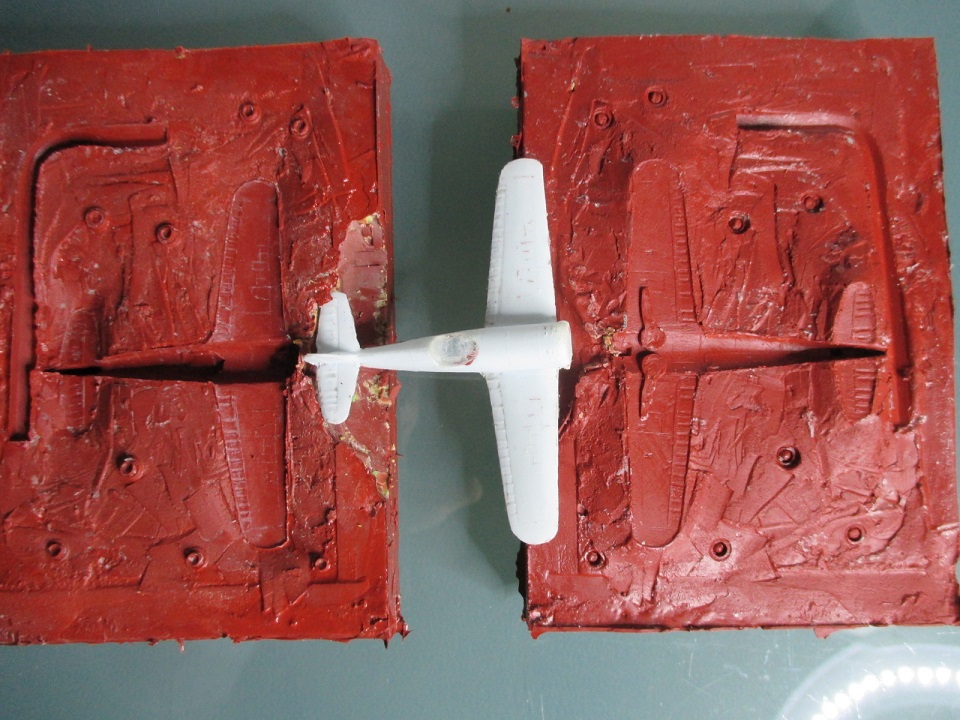
Horten Ho 229

Curtiss A-12 Shrike

MiL Mi-24 Hind

Heinkel He 112

PZL P.23 Karas
 
IAR 80


C'est tout ? Non, la suite au prochain numéro et vous verrez que tout n'est pas simple en ce bas monde...

That's all ? No, to follow on the next issue and you will see that everything is not easy in this world...